GSE Tech(Suzhou)  Co., Ltd.
News

How Much Is The Annual Electricity Cost of a Nitrogen Generator? Calculate It In 3 Minutes With 4 Key Variables

2026-10-20 0 Leave me a message


How to calculate the electricity cost of a PSA nitrogen generator?


This question seems simple, yet few people can calculate it accurately. Most inquiries start by asking "What is the power rating of this machine?" — this mindset is misleading.

A PSA nitrogen generator does not generate pressure on its own. It only separates compressed air supplied by the air compressor. The real power-consuming equipment sits upstream of it.

This article will not focus on product promotion. Instead, we break down the calculation formula. Input four variables, and you will get the actual annual electricity cost for your on-site nitrogen system.


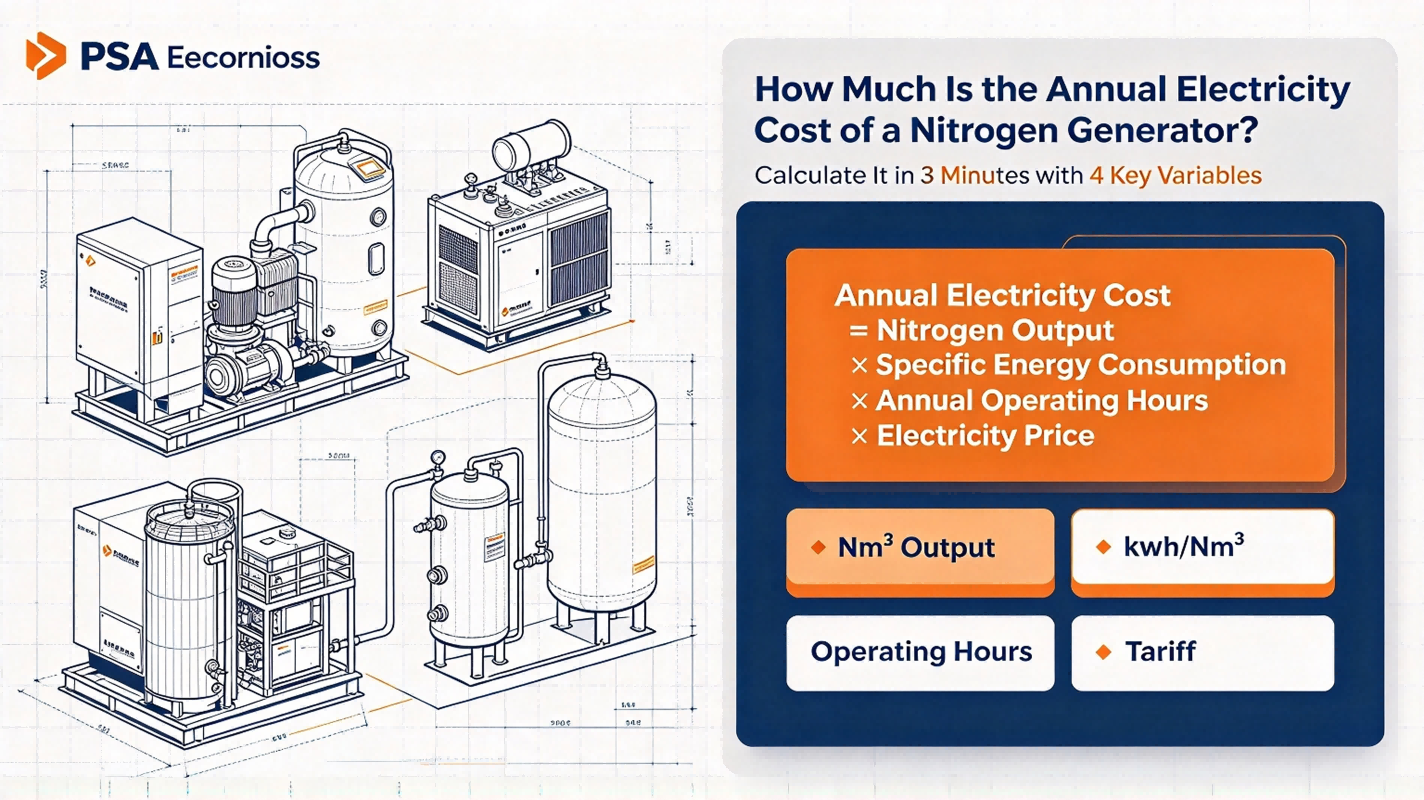
Annual Electricity Cost of Nitrogen System = Nitrogen Output × Specific Energy Consumption × Annual Operating Hours × Electricity Price

Among these four variables, specific energy consumption is the easiest to get wrong. Many buyers only check the power of the nitrogen generator host. In fact, the air compressor consumes 75% ~ 85% of the total system energy. The nitrogen generator body only powers instruments, normally less than 1 kW. Only with correct parameters can you get an accurate cost estimation.


1. Correct the Most Common Calculation Mistake

Most discussions about nitrogen generator energy consumption focus on the machine’s rated power, which is an incorrect starting point.

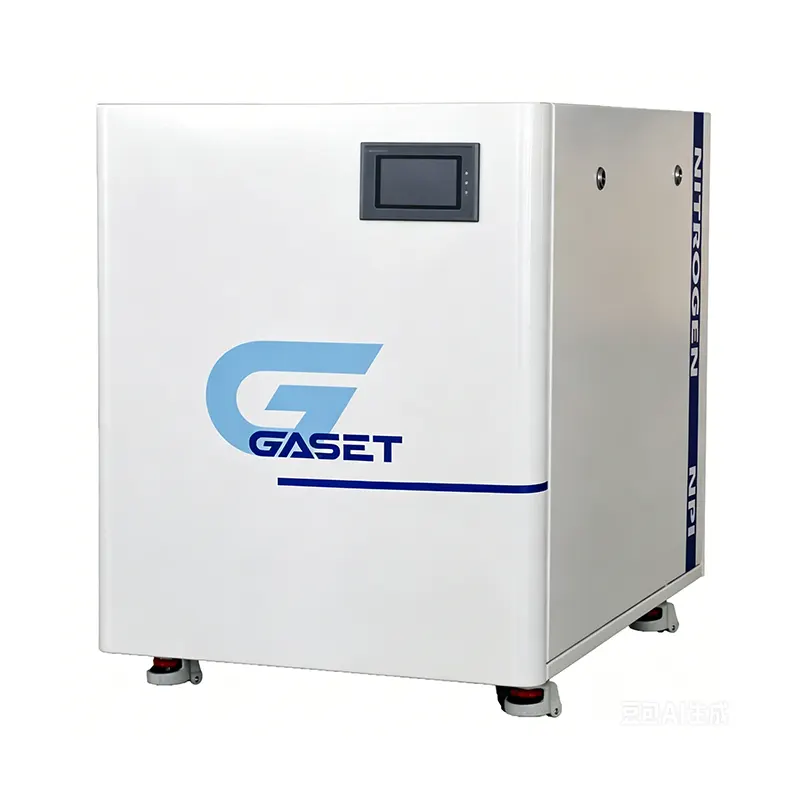
The feedstock for PSA nitrogen generators is compressed air. The unit does not build gas pressure; it uses carbon molecular sieve to trap oxygen while letting nitrogen pass through from compressed air delivered by the air compressor.

Therefore, the power consumers in the whole system are listed below:


  • Air Compressor: accounts for 75% ~85% of total energy consumption, the main power consumer
  • Refrigerated Air Dryer / Desiccant Air Dryer: removes moisture from compressed air, low power consumption level
  • Nitrogen Generator Main Unit: only PLC, solenoid valves and oxygen analyzer run, normally 0.2 ~ 0.6 kW
  • Nitrogen Booster: required only when the pressure at gas usage points is higher than adsorption pressure; this creates extra notable power consumption.


2. Step 1: Calculate Specific Energy Consumption Correctly

Specific energy consumption means the power consumed to produce 1 Nm³ nitrogen, unit: kWh/Nm³. It depends on two factors: the specific power of the air compressor, and the air-to-nitrogen ratio.

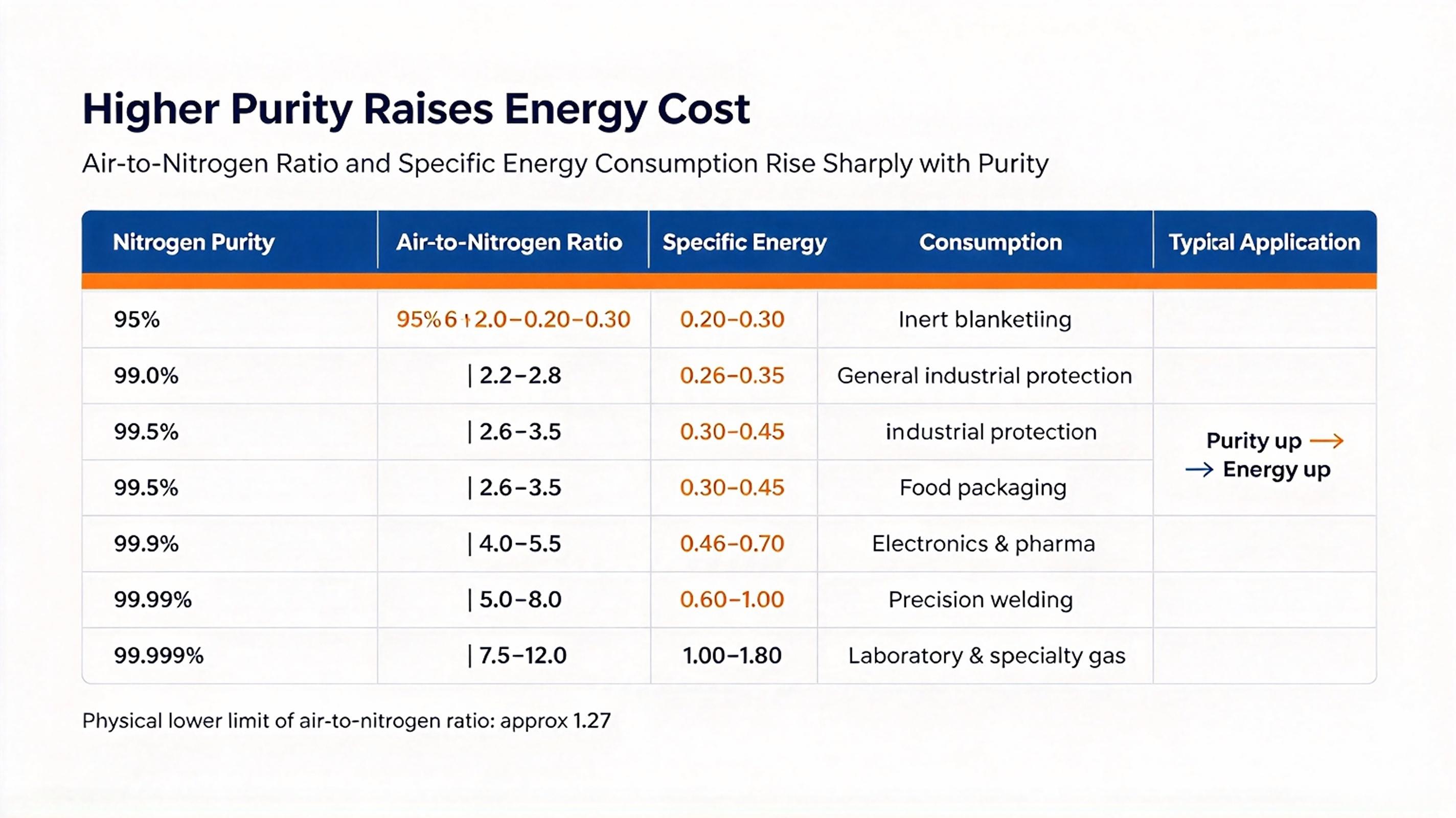
Air-to-nitrogen ratio is the core metric: the volume of compressed air required to produce 1 Nm³ nitrogen. Its physical lower limit is 1.27.

Reason: Air contains 78.08% nitrogen plus 0.93% argon. Argon will pass together with nitrogen to the product side and cannot be separated. Any claim of air-to-nitrogen ratio below 1.27 is physically impossible.

The practical air-to-nitrogen ratio is far higher than this theoretical limit for 3 reasons:

Desorption & purging will carry away part of nitrogen

Mass transfer zone at the inlet and outlet of adsorption beds cannot fully participate in separation

Pressure drop when gas flows through the sieve bed reduces available pressure difference

The air-to-nitrogen ratio rises exponentially with higher nitrogen purity. This is the engineering root cause: higher purity nitrogen costs more.


Note: Data is reference values from public industry technical documents. Normal deviation of ±15% exists between different manufacturers and working conditions. Not our on-site measured data, only for magnitude judgement.

Key takeaway from this table: Boosting purity from 99.9% to 99.99% only adds 0.09 percentage points, yet specific energy consumption may rise by 1/3 to half. The extra cost is not only for molecular sieve, but also annual electricity bills year after year.


3. Step 2: Plug in the Four Variables


Formula:

Annual Electricity Cost = Nitrogen Output × Specific Energy Consumption × Annual Operating Hours × Electricity Tariff

Two variables are frequently estimated incorrectly.


3.1 Annual Operating Hours

Many cost sheets directly fill in 8000h or even 8760h (24/7 full-year running). This is only valid under continuous operation and stable gas demand.

If your workshop only runs one shift, 250 working days × 8 hours per day = 2000 hours per year.

For the same nitrogen system, electricity cost at 2000h is 1/4 of that at 8000h. This difference has a bigger impact than selecting different machine brands.

First, answer this honestly: How many actual production hours does your nitrogen system run every year?


3.2 Electricity Tariff

Industrial power price is not a fixed number. It is divided into peak / flat / valley tiers with large price gaps; valley tariff can be only ~1/3 of peak tariff.

For continuously running equipment, calculation using a single flat rate will lead to distortion. A more realistic method is weighted average electricity price:

Sum up power consumption in each time slot multiplied by corresponding tariff, then divide total value by total power consumption. This number can be derived directly from your electricity invoice and is more accurate than published price table.

One easily overlooked item: If your factory adopts two-part electricity pricing, basic charge is collected according to transformer capacity regardless of power usage. Whether to allocate this part into nitrogen production cost depends on your internal cost accounting rules, but you need to be aware of this expense.


3.3 Calculation Example

Assume a factory needs 50 Nm³/h nitrogen, purity 99.9%, annual runtime 4000h, weighted electricity price 0.8 USD equivalent /kWh.

From table, take mid-range value: specific energy consumption = 0.55 kWh/Nm³

Annual power consumption = 50 × 0.55 × 4000 = 110,000 kWh

Annual electricity cost = 110,000 ×0.8 = 88,000

If purity requirement is reduced from 99.9% to 99.5%, take 0.38 kWh/Nm³:

Annual power consumption = 50 ×0.38 ×4000 =76,000 kWh

Annual electricity cost =76,000 ×0.8 =60,800

In this example, lowering purity from 99.9% to 99.5% saves 27,200 per year.

That’s why you should not blindly specify ultra-high purity during equipment selection. Confirm what purity your process truly requires.

This calculation is for reference only, actual value depends on factory real operating condition.


4. Why Calculated Electricity Cost Under Rated Condition Is Always Lower Than Actual Bill

The formula above works for ideal conditions. Real electricity expense tends to be higher, caused by four commonly neglected factors:


1.Fluctuating gas consumption

The formula uses rated output, while real gas demand fluctuates. When equipment runs under partial load, specific energy consumption rises. After unloading or frequency conversion, air compressor efficiency drops non-linearly; idle operation still consumes 25%~40% of full-load power. Real annual cost must be calculated with load curve instead of rated value × runtime.

2.Power consumption of drying & purification system

Refrigerated dryers, heat-regenerative desiccant dryers and pressure loss from 3-stage filters all add to power and gas cost. In a closed compressed air system, every extra 0.1 bar pressure drop across filters causes around 0.7% extra power consumption of air compressor.

3.Pipeline air leakage

This is the most hidden cost. A tiny 1mm hole under 0.8 MPa will waste a large volume of compressed air per year, with zero gas output. Investment in leakage inspection normally delivers higher return than many energy-saving equipment upgrades.

4.Booster energy consumption

If gas usage pressure exceeds adsorption pressure, a nitrogen booster is needed, typically adding around 0.05 kWh/Nm³ energy consumption. Omitting this term will significantly underestimate total electricity cost.


Therefore, when comparing quotations from multiple suppliers, do not only compare upfront prices. Calculate 10-year total electricity cost (specific energy consumption × annual hours × tariff), add this to equipment price before comparison. Price advantage can often be offset or even reversed by long-term power bills.


Related News
Leave me a message
X
We use cookies to offer you a better browsing experience, analyze site traffic and personalize content. By using this site, you agree to our use of cookies. Privacy Policy
RejectAccept